
Product details of PBI LNB Ku Band Powerful Prime Focus Santech Bottle ST-3009
- Powerful Gain
- Full HD
- Teghnoology Korea
- Packing Bubble
LNB Santech ST-3009
The bottle promo has arrived, the quality of goods and service is stable, and customers are not disappointed.
Only here!!
ORIGINAL MADE IN CHINA
For those who need a cheap Meriah Prime Focus type LNB KU Band to capture Measat 3, JCSAT, Palapa KU, Astro, and other KU band frequency satellite signals, the LNB KU Band brand Getmecom HD with 0.1 dB noise will be perfect.
Suitable for solid type dishes 6 feet (prime focus) of any brand, such as matrix alloy, or venus galvanised, and others…
Specification :
INPUT : 10.7 -12.75 ghz
OUTPUT: 950 – 2150 MHz
L.O.Low Band: 9.75 GHz
L.O.High Band: 10.66 Hz
NOISE FIGURE: 0.1-0.2-0.3 dB
GAIN: 70dB
CURRENT CONSUMPTION: 100mA
INCLUDES LNB HOLDER/BRACKET (CAN BE FOR DISH FOCUS OR OFFSET)
Only for 1 satellite and 1 receiver
What’s in the box
LNB, Ring, So
Full specifications of the product
Brand: Fuji
SKU: FU014ELAAGHKX1ANID-36950230
Warranty Type: Seller
Warranty Model: ST-309
Antenna Type: Outdoor
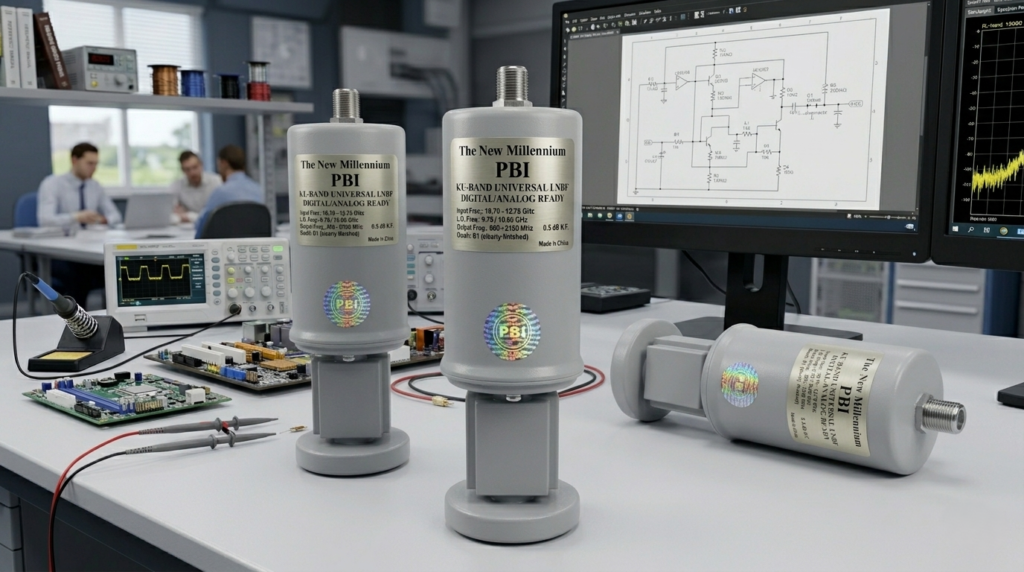
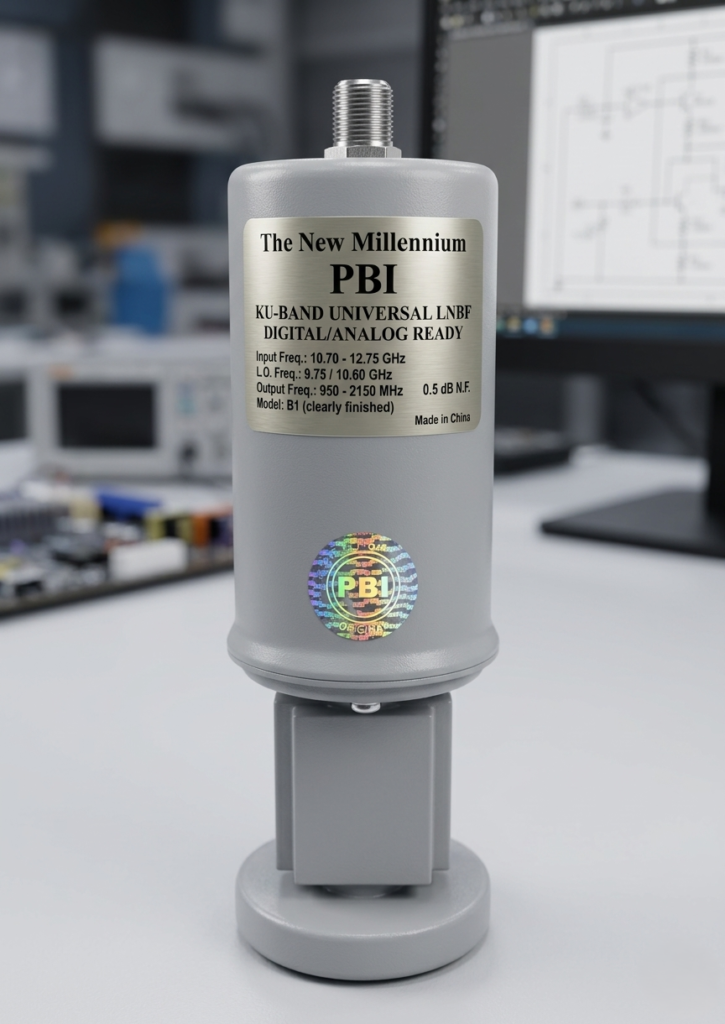
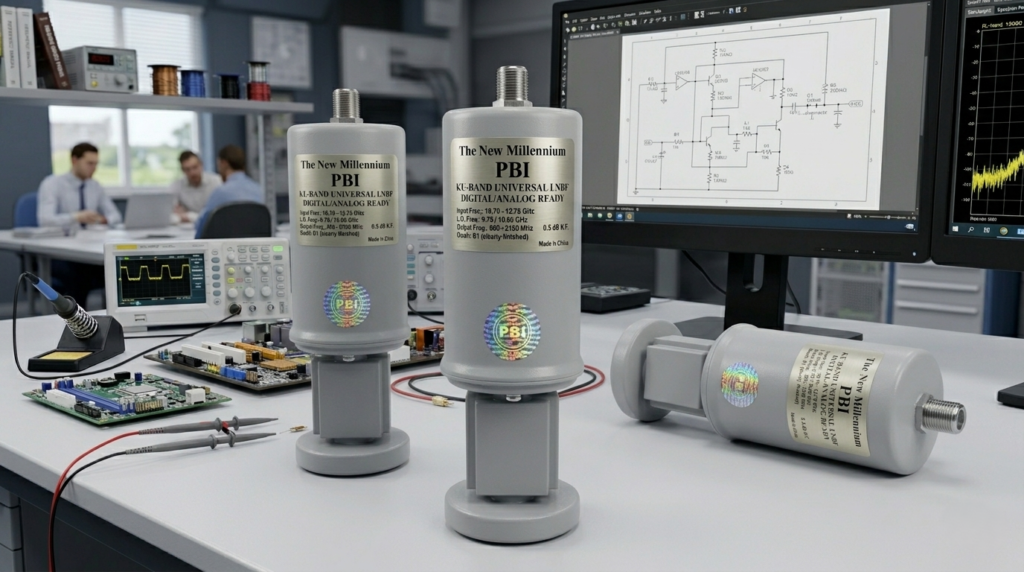
Based on the detailed labels and holograms on these devices, they are high-performance Ku-band Universal Low Noise Block downconverters (LNBs), specifically LNBFs (Low Noise Block downconverters with integrated Feedhorn), manufactured by PBI (Pro Brand International).
These are critical components in a satellite TV reception system, mounted directly at the focal point of the satellite dish.
Key Function in a Satellite Dish System
An LNB like this has two primary functions:
- Low Noise Amplification: It receives the extremely weak microwave signals reflected from the satellite dish. The very low noise figure specified on the label (0.5 dB) is crucial for amplifying these weak signals with minimal distortion.
- Frequency Block Downconversion: It converts the received high-frequency Ku-band signals (around 10-12 GHz) to a much lower intermediate frequency (IF, 950-2150 MHz).
The downconverted IF signal can travel through coaxial cable without excessive signal loss to the satellite receiver (set-top box), which then demodulates and decodes the signal for viewing.
Detailed Specifications from the Label
The labels on the LNBs in the image provide precise specifications:
- PBI (Pro Brand International): The manufacturer.
- KU-BAND UNIVERSAL LNBF: Indicates it’s an LNB with an integrated feedhorn for Ku-band reception. “Universal” signifies it can receive signals from a wide range of Ku-band frequencies.
- DIGITAL/ANALOG READY: Confirms compatibility with both modern digital and older analogue satellite TV signals.
- Input Freq.: 10.70 – 12.75 GHz: This is the specific range of Ku-band frequencies the LNB is designed to receive from the satellite.
- L.O. Freq. (Local Oscillator Frequency): 9.75 / 10.60 GHz:
- Satellite signals are typically transmitted in two frequency bands within the Ku-band (often called “Low Band” and “High Band”).
- This LNB has two different internal local oscillator frequencies: 9.75 GHz (used to downconvert the Lower Ku-band) and 10.60 GHz (used to downconvert the Upper Ku-band).
- The satellite receiver switches between these two L.O. frequencies by sending specific voltage signals (usually 13V or 18V) up the coaxial cable to the LNB.
- Output Freq.: 950 – 2150 MHz: This is the Intermediate Frequency (IF) range that the LNB outputs down the coaxial cable.
- 0.5 dB N.F. (Noise Figure): This is a critical metric. A lower noise figure indicates the LNB adds less noise to the signal during amplification, resulting in better picture and sound quality. 0.5 dB is a good value for standard LNBs.
- Model: B1: The specific product model number.
- Hologram: The “PBI ORIGINAL” hologram is a security feature to deter counterfeiting.